What Your Rear Derailleur Is Trying to Tell You
Your rear derailleur is the hardest-working mechanical system on your bike. It translates tiny cable movements into precise chain placement across 10, 11, or 12 cogs — while you’re pedaling under load, bouncing over rough pavement, and spraying it with road grit. When it works, you don’t think about it. When it doesn’t, every pedal stroke reminds you.
The good news: derailleurs almost never fail without warning. They talk to you first. Here’s what they’re saying.
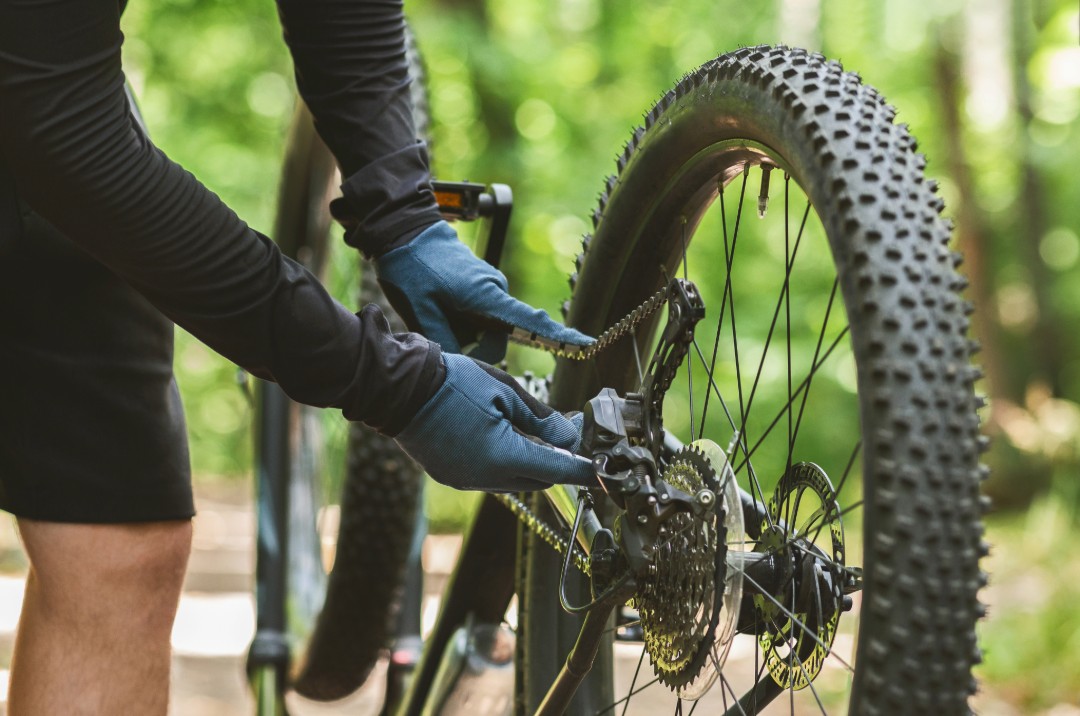
The click that won’t stop
A rhythmic clicking that follows your cadence — one click per pedal revolution — usually means your chain is trying to shift but can’t quite commit. It’s sitting between two cogs, catching on one and releasing.
What’s happening: Cable tension is slightly off. Cables stretch over time (especially new cables in their first few hundred miles), and even a millimeter of slack changes the derailleur’s alignment.
The fix: This is often a quarter-turn of the barrel adjuster. Turn it counterclockwise (from the rider’s perspective) to add tension if the chain is struggling to climb to a larger cog. Clockwise if it’s not dropping to a smaller one. Small adjustments — a quarter turn at a time, then test.
When it’s not cable tension: If barrel adjuster tweaks don’t fix it, the derailleur hanger might be bent. This is the small aluminum tab that connects the derailleur to the frame. It’s designed to bend (better the hanger than the frame), and it doesn’t take much — leaning the bike against a wall wrong can do it. A bent hanger needs a professional alignment tool to straighten.
Ghost shifting
The chain jumps to a different gear on its own, usually under hard pedaling. You didn’t touch the shifter. The bike just decided to shift.
What’s happening: Usually a sticky or frayed cable. The cable isn’t moving freely through the housing, so tension builds up and releases suddenly. In San Francisco’s damp climate, internal cable corrosion is extremely common — the housing looks fine from outside while the cable rusts from within.
What to do: If you squeeze the cable housing and see cracking or feel grit, replace the cable and housing together. This is a $15–25 parts job that makes a dramatic difference. If the cables look fine, check for a worn chain — a stretched chain doesn’t seat properly on the cassette teeth and can skip under load.
Sluggish upshifts
Shifting to an easier gear (larger cog) feels slow and reluctant. You click the shifter and wait… and eventually the chain climbs over.
What’s happening: The derailleur spring is fighting against insufficient cable tension. The spring pulls the derailleur toward the smallest cog (hardest gear), and the cable pulls it the other way. When cable tension drops — from stretch, friction, or housing compression — the upshift loses authority.
What to do: Again, start with the barrel adjuster. But if the derailleur is old and has a lot of miles on it, the spring itself may be weakening. Derailleur springs don’t last forever — after 10,000–15,000 miles, pivot points wear and spring tension drops. At that point, it’s time for a new derailleur rather than chasing adjustments.
Can’t reach the biggest or smallest cog
You shift all the way to one end but the chain won’t go to the last gear.
What’s happening: This is usually a limit screw issue. Your derailleur has two tiny screws (marked H and L) that set the physical boundaries of how far it can move. If the chain can’t reach the largest cog, the L (low) screw is too tight. If it can’t reach the smallest, it’s the H (high) screw.
A word of caution: Limit screws exist to keep your chain from going where it shouldn’t — into your spokes on one side, or off the cassette and into the frame on the other. Loosening them without understanding what you’re doing can cause real damage. If you’re not confident, this is a good one to have a mechanic handle.
Noise under load but not when coasting
You pedal and hear grinding or ticking. You stop pedaling and coast — silence. Start pedaling again — noise returns.
What’s happening: This is classic chain or cassette wear. A worn chain (stretched beyond 0.5% on a chain checker tool) doesn’t mesh cleanly with cassette teeth. Under the tension of pedaling, it grinds. When you coast, there’s no load, so no noise.
The expensive lesson: A new chain is $15–30. A new cassette is $30–80. If you ride a worn chain too long, it wears the cassette teeth into a shape that only fits the stretched chain. Then when you finally replace the chain, the new chain skips on the worn cassette and you’re replacing both. Check chain wear every 500 miles. A $15 chain checker tool pays for itself on the first use.
The trail-side reality check
Most of these problems get worse gradually. You adapt to slightly rough shifting without realizing it. Then one day you ride someone else’s bike and realize how far off yours has drifted.
A quick way to check: shift through your entire gear range while riding. Every gear, both directions. If any shift hesitates, clicks, or requires a double-tap, your derailleur is talking. Listen to it before a minor adjustment becomes a major repair.
Presidio Bikes is a mobile bike repair service in San Francisco. We come to your location for tune-ups, derailleur adjustments, and everything else your bike needs.
Text or call (415) 723-8600 to book same-day service.