Your Chain Is the Cheapest Part That Ruins the Most Expensive Ones
There’s a part on your bike that costs about $20, weighs a few ounces, and — if you ignore it — will quietly destroy $300 or more in other components. That part is your chain.
Most riders think about chains the way they think about shoelaces: it’s there, it works, why would I think about it? The answer is that a worn chain doesn’t just stop working on its own. It takes the cassette and chainrings down with it.
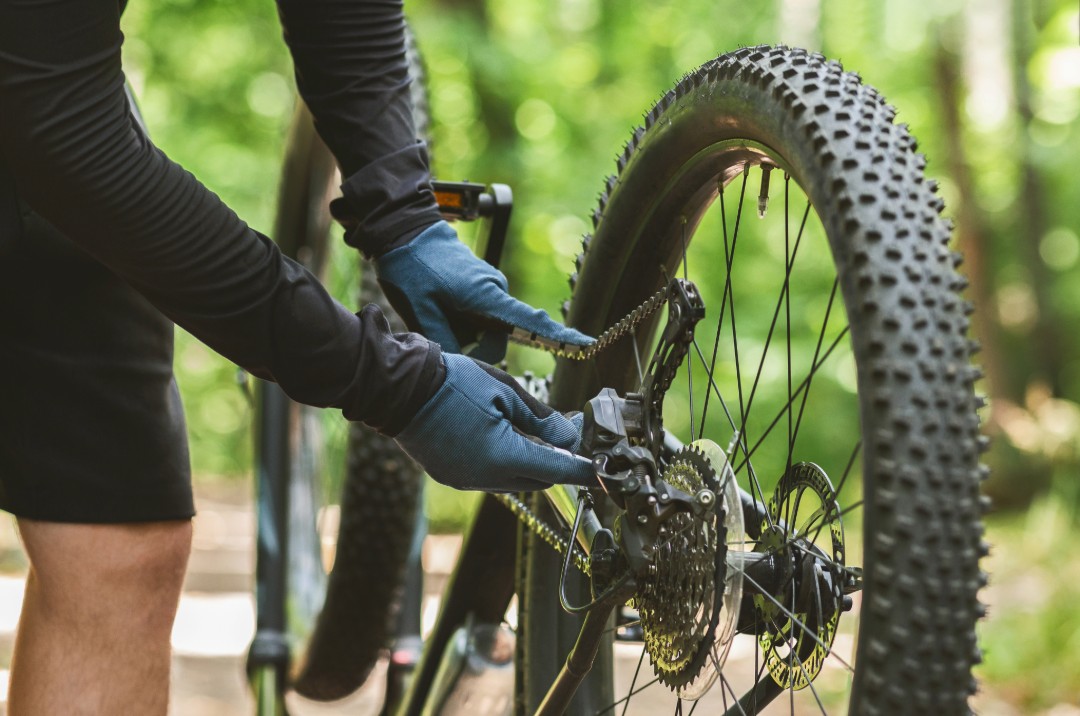
What “chain stretch” actually means
Chains don’t stretch like a rubber band. The metal plates aren’t getting longer. What’s actually happening is the bushings — the tiny cylinders inside each link where the pin rotates — are wearing down. As the bushings erode, each link gets slightly longer. Multiply that across 116 links and the entire chain grows measurably.
The standard chain pitch is 12.7mm (half an inch) between pins. A new chain measures exactly that. A worn chain doesn’t. And the difference matters more than you’d think.
The numbers that matter
Chain wear is measured in percentage of stretch:
- 0.5% — Replace now if you’re running an 11 or 12-speed drivetrain. These narrower chains and tighter-tolerance cassettes are less forgiving of wear.
- 0.75% — The replacement threshold for 10-speed and below. At this point, the chain is actively damaging your cassette.
- 1.0% — You’ve waited too long. The cassette is almost certainly compromised. You’re probably replacing both.
A chain checker tool costs about $15 and takes five seconds to use. It’s the cheapest diagnostic tool in cycling.
How a worn chain kills everything it touches
Here’s the mechanism. Each tooth on your cassette and chainring is shaped to mesh with a chain at the correct 12.7mm pitch. As the chain stretches, each link sits slightly higher on the tooth. Instead of the load being distributed across multiple teeth, it concentrates on fewer contact points.
Those contact points wear into a hook shape. Once the teeth are hooked, they only mesh correctly with a stretched chain. Put a new chain on a hooked cassette and it’ll skip under load — the new chain’s correct pitch doesn’t match the worn tooth profile.
This is the expensive lesson: a $20 chain replacement becomes a $200-400 chain-plus-cassette-plus-chainring replacement because you rode an extra thousand miles on a worn chain.
How long chains actually last
The generic answer is 2,000 to 3,000 miles. The real answer depends on where and how you ride.
Factors that shorten chain life:
- Wet and gritty conditions. Moisture carries abrasive particles into the bushings. Riding through San Francisco’s fog belt or on wet Bay Area trails accelerates wear significantly. A chain that would last 3,000 miles in dry conditions might hit 0.5% stretch at 1,500 miles here.
- Hills. High-torque pedaling under load — standing climbs, hard accelerations — puts more stress on chain pins and bushings than flat-ground spinning.
- Cross-chaining. Running the chain at extreme angles (big ring to big cog, or small to small) increases lateral stress and accelerates wear at the pin-bushing interface.
- Neglecting lubrication. A dry chain wears dramatically faster. Metal on metal without lubrication is just grinding.
Factors that extend chain life:
- Regular cleaning and lubing. Every 100-150 miles, or after any wet ride. Use wet lube for commuting in damp conditions; dry lube for fair weather.
- Smooth shifting habits. Easing pedal pressure during shifts reduces shock loads on the chain.
- Keeping the drivetrain clean. Grit embedded in chain lube is sandpaper running through your drivetrain every pedal stroke.
The math that should convince you
Let’s say you replace your chain every 2,000 miles at $20-30 per chain. Over 10,000 miles, that’s five chains — roughly $100-150 total.
Your cassette, if you’re replacing chains on time, can last through three to four chains — maybe 6,000-8,000 miles. One cassette replacement in that span: $40-80.
Total drivetrain cost over 10,000 miles with regular chain replacement: $140-230.
Now the alternative: you never check chain wear. You ride one chain for 5,000 miles until shifting gets terrible. The chain is at 1.0% stretch. The cassette is hooked. The chainring teeth are shark-finned. You’re replacing everything at once: chain ($30), cassette ($60-120), chainring ($40-150).
That’s $130-300 in one shot — and you’ll be back in the same situation in another 5,000 miles because you’ll do the same thing again.
Over 10,000 miles, the “ignore it” approach costs roughly the same or more, and you spend significant time riding a bike that shifts poorly, skips under load, and sounds like a cement mixer.
How to check your chain in 30 seconds
With a chain checker: Drop the tool into the chain. If the gauge falls fully into the chain at the 0.5 mark, you’re at 0.5% wear. Simple.
Without a tool: Measure 12 complete links (pin center to pin center). That should be exactly 12 inches on a new chain. If it measures 12-1/16" or more, you’re past 0.5%. At 12-1/8", you’re at 1.0% — replacement is overdue.
The pull test: Grab the chain on the front chainring and pull it away from the teeth. If you can see significant daylight between the chain and the chainring teeth, the chain has stretched. This isn’t precise, but it’s a quick gut check.
The one habit that saves you money
Check your chain every 500 miles. That’s it. One measurement, five seconds, every few weeks if you’re a regular rider. Catch it at 0.5% and replace it: $20 and 15 minutes of work. Miss it until 1.0% and you’re looking at a full drivetrain rebuild.
The cheapest part on your bike is also the one that protects — or destroys — the most expensive ones. Pay attention to it.
Presidio Bikes is a mobile bike repair service in San Francisco. We check chain wear as part of every tune-up and come to your location — no need to bring your bike anywhere.
Text or call (415) 723-8600 to book same-day service.